


Voices From Eritrea: Compiled by Ahmeddin Osman
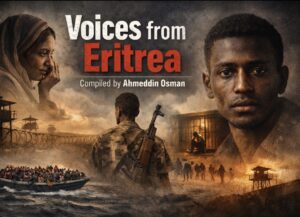
Eritrea is a place where silence is demanded, and yet voices persist. The stories here are not of one person, but composite voices, drawn from real experiences of people living inside the country and in the diaspora. They speak of fear, loss, hope, and survival. Let us hear them.
Saliha, 31
“When I hear about prisoners being released, I don’t celebrate. My uncle was taken years ago. No court. No explanation. We don’t even know if he is alive or dead. Families like mine, we need answers, not propaganda. Justice is not revenge. Justice is knowing. Justice is truth. Without truth, we are all still prisoners.”
Berhane, 18
“Every day I wake up and ask myself, is this all my life will be? No internet. No real university. No job. No way to dream. They say ‘be patient.’ But patience does not feed hope forever. We are young, but we live like we are already punished. If this doesn’t break your heart, I don’t know what will.”
Omar, 22
“The sea raised my family. Now we cannot go there. I watch it from far away like it is not ours anymore. Fishing was our life. The government killed it. They tell us to survive without our survival. Many of my people fled. Some died on the way. This is not development. This is punishment. They broke us and then blamed us for leaving.”
Yonas, 34
“We grew up hearing about independence, about sacrifice, about freedom. Now we live without elections, without voices, without choice. One brutal party. One truth. Anyone asking questions is an enemy. An entire generation trapped between endless service and running for their lives. History will ask how this happened. I hope we have the courage to answer.”
Hasan, 35
“Sometimes I just list everything Eritrea doesn’t have, and I start shaking. No elections. No free press. No internet. No universities. No parliament. No future. Journalists locked away like they never existed. Dawit Isaak and many more disappeared and the world moved on. An entire generation forced to choose between slavery and exile. This is not politics. This is not nation salvation. This is human suffering. And silence makes it worse.”
Samuel, 29
“When I left Eritrea, I thought the nightmare ended. But it didn’t. Then came the phone calls, the pressure, the warnings. Pay the tax. Stop talking. Remember your family. I feel guilty for surviving. I feel angry for being silent. Exile is not freedom when your government still has its hands around your throat.”
Abdu, 26
“I crossed borders and deserts to be free, but fear came with me. I lower my voice when I talk about Eritrea. I think about my mother before I speak. They still demand the 2% tax. They still watch us. They still threaten us through our families. Even outside, we are not safe. Freedom should be breathing, but for us, fear follows everywhere.”
Kidane, 21
“They say national service is for the country, but the country gives nothing back. No end date. No freedom. Just orders. Just waiting. Friends disappear. Some escape. Some die at the border. If they catch you, they lock you underground, in metal containers, in the heat. People call this discipline. I call it fear used as policy.”
Mohammed, 17
“I am only 17 but I feel like my life is finished before it even started. Next year they will send me to a military camp, Sawa, and call it school. I don’t want to hold a gun. I just want a future. After that, they say I must work forever for the state, no choice, no end. People ask me why I want to leave. I don’t want to leave. I just don’t want to disappear.”
Rahel, 24
“I pray quietly now. My religion is not one of the approved ones. I learned to hide my faith like it is a crime. People were taken for believing differently, years in prison, no trial, no rights. Imagine being punished just for how you pray. They didn’t only imprison bodies; they tried to imprison our souls.”
Reference & Clarification
The stories above are composite voices, not linked to specific individuals. They reflect the real and widely documented lived experiences of Eritrean people inside the country and in the diaspora. Details are generalised to protect safety while remaining faithful to lived realities.
