Isaias Afwerki and Teodoro Obiang: Two presidents, one troubling legacy?
30261029 Habtom Yohannes Kinzareb
Isaias Afwerki
Eritrea · In power since 1991
Teodoro Obiang Nguema Mbasogo
Equatorial Guinea · In power since 1979
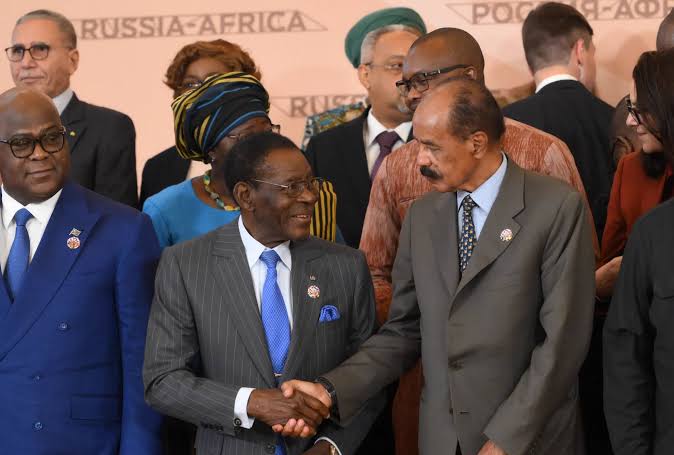
The handshake at the Third Russia–Africa Summit in Moscow brings together two of Africa’s longest-serving presidents. Their political origins differ, but their legacies invite a striking comparison: both came to power promising national transformation, yet both are associated with highly centralised personal rule, severe restrictions on political freedoms and the absence of meaningful democratic competition.
The central question is not simply how long they have ruled, but what their decades in power have delivered to their people.
1. Comparing their political legacies
🇪🇷Isaias Afwerki — Eritrea
Led the Eritrean independence struggle; became president in 1993.
More than three decades (35) years in power
No national elections since independence; the ruling party monopolises political power.
Independent media were shut down in 2001; political dissent is severely repressed.
A militarised economy, indefinite national service and large-scale emigration.
No credible democratic mechanism for a change of government.
🇬🇶Teodoro Obiang — Equatorial Guinea
Seized power in a military coup in 1979, overthrowing his uncle.
Moren than four decades in power, making him one of the world’s longest-serving presidents.
Elections are held, but they are neither free nor fair, according to Freedom House.
Opposition parties, journalists and civil society face restrictions, intimidation and arrests.
Oil wealth has not translated into broadly shared prosperity; wealth and power are concentrated around the ruling family.
The president’s son, Teodorín Nguema Obiang, is widely viewed as a potential successor.
2. Where their legacies differ
Isaias Afwerki: the unfulfilled promise of liberation
Isaias’s historical standing is inseparable from Eritrea’s long struggle for independence. Many Eritreans associated his leadership with national liberation, self-determination and the hope of building an independent, law-governed state.
The tragedy of his legacy is the contrast between that promise and the political reality: no national elections, no functioning national legislature since 2010, suppression of independent journalism, arbitrary detention and indefinite national service. Human Rights Watch +1
Obiang: the concentration of oil wealth and political power
Obiang’s legacy is closely associated with the discovery and exploitation of oil, which transformed Equatorial Guinea’s national economy. However, the country’s substantial petroleum wealth has coexisted with poverty, corruption allegations, weak public accountability and serious human rights abuses.
Human Rights Watch has documented how oil revenues helped entrench the ruling elite rather than ensure that the population benefited equitably.
3. Their common legacy: the state becomes an extension of the ruler
Three fundamental similarities stand out:
* Personalised power: Institutions capable of independently checking the president are weak or absent.
* Restricted accountability: Citizens cannot reliably remove their leaders through genuinely competitive elections.
* National interests conflated with regime interests: Criticism of the government can be treated as a threat to the state itself, rather than as a legitimate part of public life.
There is, however, an important distinction. Eritrea emerged from a successful independence struggle, while Obiang took power by overthrowing his uncle. Their routes to power and their countries’ economic structures differ. The comparison concerns their subsequent systems of rule, not an assertion that their histories are identical.
4. What does their handshake in Moscow symbolise?
Their meeting at the Russia–Africa Summit is a reminder that international diplomacy often brings together governments with very different historical experiences but similar approaches to maintaining political power.
A handshake does not, by itself, establish a political alliance or prove that the two presidents share every policy. It does, however, offer an opportunity to ask whether diplomatic engagement with long-serving leaders is accompanied by meaningful attention to democracy, human rights and public accountability.
🥲Isaias’s legacy is particularly painful because the leader associated with national liberation has presided over the denial of political freedom to the people who were supposed to benefit from it.
Obiang’s legacy is marked by the persistence of authoritarian rule alongside the concentration of oil wealth and political privilege.
🌺Both will ultimately be judged not by the number of years they held office or the leaders they shook hands with, but by whether their citizens enjoyed freedom, dignity, justice and a genuine say in their country’s future.🌹
🌺The decisive question for both leaders is this: will history remember them for strengthening their nations, or for making their nations dependent on themselves?🌹
By Habtom,Yohannes (Journalist)